10 Books on Writing, Including a 1M-Copy Classic
The best books on writing make you want to close the book and start writing. Stephen King’s On Writing, Anne Lamott’s Bird by Bird, Ursula K. Le Guin’s Steering the Craft, and William Zinsser’s On Writing Well are great places to begin.
This 2026 list includes 10 books for fiction, nonfiction, memoir, style, grammar, creativity, and getting unstuck. Some are practical manuals. Others mix advice with stories from the author’s own life.
The picks were chosen for useful advice, clear language, exercises, lasting value, and the kind of writer each book helps most. Natalie Goldberg’s Writing Down the Bones also brings a big number to the list: its publisher says the book has sold more than 1 million copies.
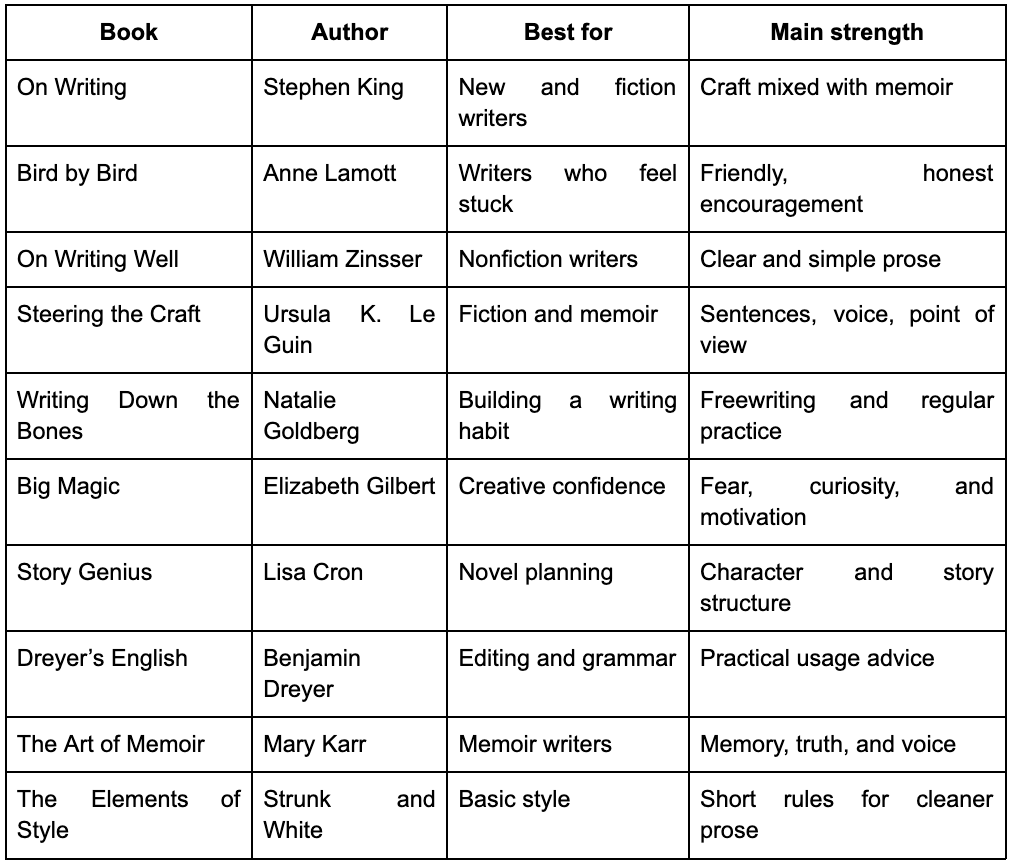
The 10 books at a glance
Why reading about writing can actually help
Good writing books do more than explain grammar. They show how other writers deal with bad first drafts, weak openings, confusing plots, fear, revision, and the strange feeling that every sentence sounded better inside your head.
They are also useful because no single book solves every problem. A novelist may need help with character motivation, while a student may simply need to make an argument clearer.
Students who are already juggling research, classes, and deadlines sometimes look to paper writers for hire at EssayHub when they need outside help with a draft, an outline, or a difficult assignment. That kind of support can sit alongside reading and practice, but the student should still understand the ideas and learn from the final work. The Harvard College Writing Center offers free guides on thesis statements, introductions, paragraphs, organization, and analytical questions.
How we chose the best books on writing
The strongest books had to offer advice that a reader could actually try. Famous authorship alone was not enough.
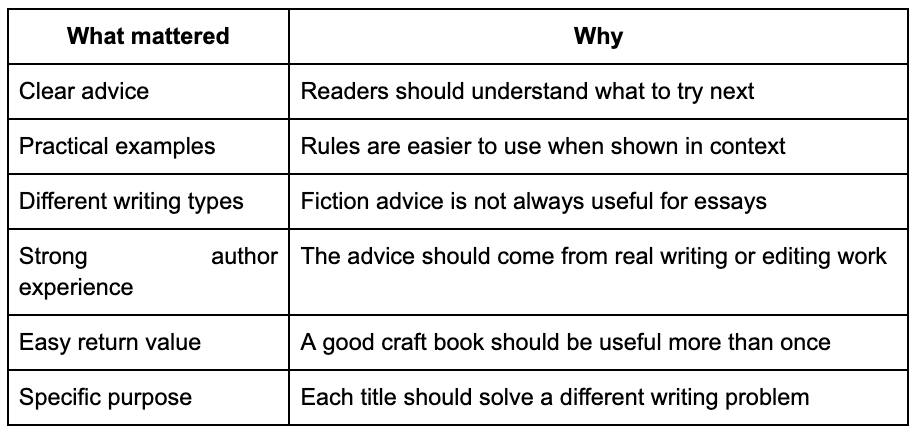
Five things mattered most: clarity, practical value, range, staying power, and the type of problem the book solves. Publisher and author pages were used to check editions, subjects, and the stated focus of each title.
The final list also needed variety. It includes creative writing books for novelists, a memoir guide, books about sentence-level style, and options for people who struggle more with fear or consistency than grammar.
Ryan Acton, an EssayHub expert whose published guides cover essay structure, research, and academic writing, often breaks writing tasks into clear stages such as reading, outlining, drafting, and revising. That same approach makes sense here: choose a book based on the specific part of writing you want to improve rather than trying to read every craft book at once.
What we looked for
10 books about writing worth reading in 2026
These books about writing cover the craft from first idea to final edit.
On Writing
Stephen King’s On Writing is one of the easiest craft books to recommend because it mixes writing advice with the story of King’s own life. King’s official site describes it as both a textbook for writers and a memoir. It was first released in 2000.
The craft sections are direct. King talks about vocabulary, grammar, description, dialogue, reading, revision, and the habit of actually sitting down to work.
That mix makes the book useful even if horror is not your favorite genre. You do not need to want a Stephen King-style career to learn from his focus on regular writing and clear prose.
Best for: beginners who want practical advice without feeling as if they are reading a textbook.
Bird by Bird
Anne Lamott’s Bird by Bird is a good choice when the emotional side of writing is harder than the technical side. The book deals with first drafts, perfectionism, writer’s block, jealousy, finding material, and simply getting through a large project one piece at a time.
Penguin Random House calls it a long-running guide for writers and notes that a twenty-fifth-anniversary edition was released after generations of readers had used the book.
Lamott is funny about how messy writing can feel. That makes the advice easier to hear.
Among the best books about writing, this is less about rules and more about staying sane long enough to finish something.
Best for: writers who overthink, delay, or expect the first draft to be perfect.
On Writing Well
William Zinsser’s On Writing Well is a classic guide to nonfiction. HarperCollins describes it as a book about writing clearly across many forms of nonfiction. The current publisher page lists the book at 336 pages.
Its central idea is refreshingly simple: remove clutter and make every sentence earn its place. That applies to essays, articles, reports, travel writing, memoirs, and business communication.
The book is especially helpful for writers who think formal writing needs long words and complicated sentences. Zinsser shows the opposite.
It is a strong example of best writing advice that transfers from one subject to another.
Best for: students, bloggers, journalists, and anyone who writes nonfiction.
Steering the Craft
Ursula K. Le Guin’s Steering the Craft focuses closely on the actual tools of storytelling. Her official site says the revised edition contains ten chapters covering areas such as language sound, sentence construction, and point of view. It also includes exercises for solo writers and groups.
Le Guin first published the book in 1998 and substantially revised it for a 2015 edition.
This is one of the best books on writing fiction if you already have ideas but want more control over the sentences themselves. It is less concerned with motivation and more interested in technique.
Best for: fiction and memoir writers ready to work closely on language.
Writing Down the Bones
Natalie Goldberg’s Writing Down the Bones treats writing as a practice rather than a performance. Shambhala says Goldberg connects regular writing practice with her experience of Zen meditation.
The exercises encourage writers to keep moving, notice ordinary life, and get past the voice that wants to judge each sentence before it exists.
The book has had remarkable staying power. Shambhala says it has sold more than 1 million copies and has been translated into 19 languages.
That makes it one of the most widely read books for writers on this list.
Best for: people who want to write more often and stop editing every sentence while drafting.
Big Magic
Elizabeth Gilbert’s Big Magic is about creativity more broadly, but writers will recognize many of its problems. Fear, perfectionism, curiosity, frustration, and the pressure to make every creative project important all appear in the book.
Penguin Random House describes it as a look at Gilbert’s creative process and her ideas about inspiration, habits, curiosity, and facing fear. The paperback edition runs 304 pages.
This is not the book to buy if you need to fix weak dialogue or learn punctuation. It is for the days when you know how to write but cannot convince yourself to begin.
Among the best books for writers, it fills the motivation slot well.
Best for: creative people whose biggest obstacle is fear.
Story Genius
Lisa Cron’s Story Genius is aimed at writers who have an idea for a novel but cannot make the story hold together. Penguin Random House describes it as a step-by-step system for building a scene-by-scene novel blueprint around character and internal motivation.
Cron’s approach puts the character’s inner problem before a pile of external plot events. The book contains exercises that move from the first idea toward a complete draft plan.
It will not suit every novelist. Writers who dislike planning may find it too structured.
Still, people searching for books on how to write a novel rather than simply how to improve prose will get much more practical direction here.
Best for: novelists who struggle with structure and character motivation.
Dreyer’s English
Benjamin Dreyer’s Dreyer’s English makes grammar and copy editing surprisingly entertaining. Dreyer spent decades working in publishing and became Random House’s copy chief.
The book covers punctuation, spelling, grammar, commonly overused words, and many supposed rules that writers do not actually have to obey. Penguin Random House notes, for example, that Dreyer discusses split infinitives and beginning sentences with “And” or “But.”
This is a creative writing book only in the broadest sense. Its real strength appears after the creative part, when a writer has to clean up the draft.
Best for: writers who want sharper sentences without a dry grammar lecture.
The Art of Memoir
Mary Karr’s The Art of Memoir focuses on turning real life into a story without flattening memory into a list of events. HarperCollins describes the book as an accessible exploration of memoir built from Karr’s experience as both a memoirist and teacher.
Memoir creates problems that fiction writers do not always face. The people were real, memories may conflict, and the writer has to decide what belongs on the page.
Karr is especially useful for thinking about voice and honesty. A memoir needs more than unusual events. It needs a clear mind to tell the story.
Readers searching for the best books on writing personal material should put this near the top.
Best for: memoirists and personal essay writers.
The Elements of Style
The Elements of Style is the shortest and most rule-focused pick here. William Strunk originally published the guide in 1918, and later editions became closely associated with E. B. White. Simon & Schuster describes it as a highly influential American guide to grammar, usage, and composition.
Its advice favors direct sentences and cutting unnecessary words. Some of its rules have been debated for years, so it works better as a compact style guide than as unquestionable law.
It remains useful because it makes writers notice their sentences.
Readers building a small shelf of writing books can pair it with a looser book, such as Bird by Bird or Writing Down the Bones.
Best for: quick reminders about clean, direct prose.
Which writing book should you start with?
The right book depends on what is going wrong in your writing right now. Do not begin with a grammar manual if the real problem is that you cannot finish a first draft.
Choose by the problem you want to solve
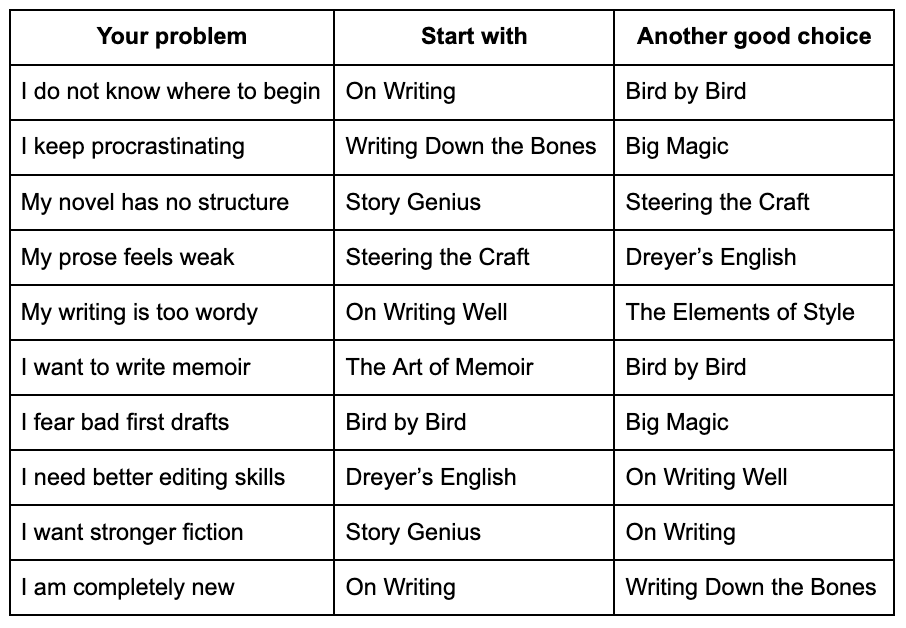
The best books on writing are often the ones that meet you at the right stage. A writer planning a first novel has different needs from someone polishing a tenth draft.
A simple 2026 reading order
You do not need to read all 10 in one month. A better approach is to match one book with one piece of writing.
A useful reading path
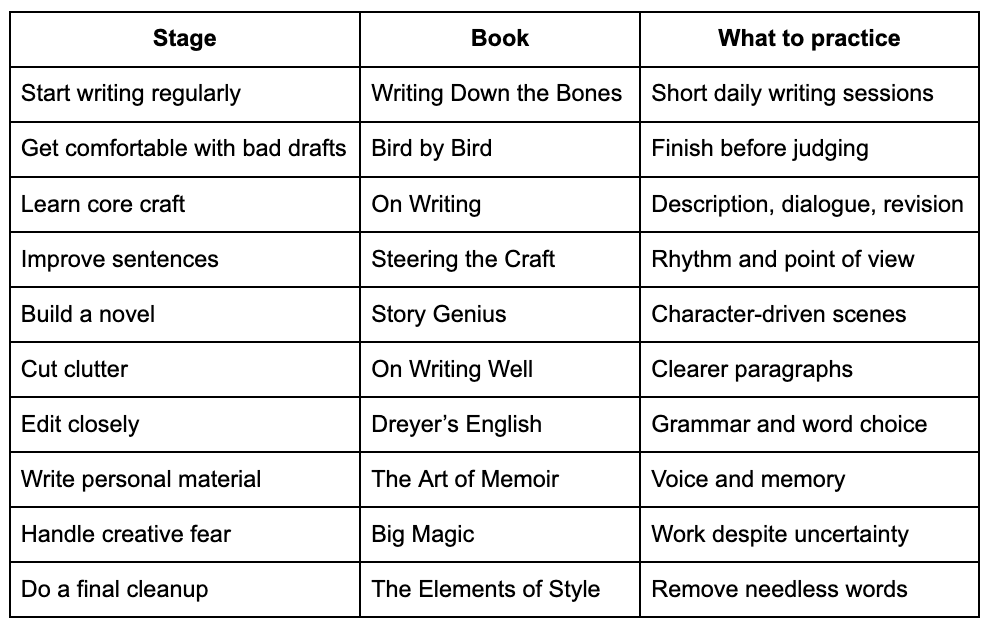
Many lists of books about writing make the mistake of treating reading itself as progress. Reading craft advice feels productive, but the real test is whether you apply one idea to your own work.
Try reading one chapter and then writing. That is usually more useful than finishing three craft books before opening your document.
Frequently asked questions
What is the best book on writing for beginners?
On Writing by Stephen King is one of the easiest places to start. It combines personal stories with direct advice on reading, drafting, description, dialogue, and revision.
What are the best books for learning fiction?
Story Genius, Steering the Craft, and On Writing cover three different needs. Cron focuses on story structure, Le Guin works closely with narrative technique, and King offers broad craft advice.
Do writing books actually make you a better writer?
They can help, but only when the advice is used in real writing. A craft book can explain a technique or reveal a weakness, while regular drafting and revision are what turn that lesson into a skill.
Which book is best for nonfiction writing?
On Writing Well is the strongest general nonfiction choice on this list. HarperCollins describes it as a classic guide to nonfiction, with an emphasis on clear and readable prose.
How many writing books should I read?
Start with one book that matches your current problem. The goal is not to own every guide but to find advice you can use in your next paragraph, story, essay, or revision.