

How to Create a Cozy Reading Nook at Home: A Book Lover’s Guide to the Perfect Reading Corner
Picture a quiet Saturday morning. The rest of the house is still. Your tea is hot. The book on your nightstand has been calling your name for three days straight — and for once, you have nowhere to be. The only thing missing is a space that feels made for exactly this moment.
That space doesn’t happen by accident. A truly great reading nook is designed, not stumbled into — and if you’ve been eyeing that underused corner of your living room, this guide is your sign to finally do something with it.
The timing couldn’t be better. According to Zillow’s 2026 Home Trends Report, reading nooks now appear in home listings 48% more often than in previous years, reflecting a genuine cultural shift toward screen-free, intentional spaces inside the home. A study by Feather & Black of 2,000 people found that 1 in 10 are actively planning to invest in a reading nook — and among the 25–34 age group, that figure climbs to 24%. Reading spaces are having a moment, and book lovers are leading the charge.
Whether you have a spare room, a window alcove, or just an awkward corner beside a sofa, here is everything you need to build a reading nook that feels completely, unmistakably yours.
Find Your Spot
The first thing to know: you do not need a separate room. Some of the most beloved reading nooks in the world are carved out of corners that already exist in a home — all it takes is intention.
The most popular option for good reason is the living room corner. It lets your nook be a lifestyle statement: visible, welcoming, and fully part of your home rather than hidden away. A window alcove is a close second, offering natural light that makes reading easier on the eyes. Under a staircase or in a quiet bedroom corner can also work beautifully, depending on how much privacy you want from the rest of the household.
When you’re scoping your options, follow the light. The Feather & Black study found that 54% of people name natural light as a must-have element in a reading nook — more than shelving, more than a side table, more than almost anything else. A spot near a window, even a small one, will always feel better than the same setup in a dim interior corner.
Look for low-traffic zones, too. A reading nook only works if you can actually settle into it — if it sits in the path between the kitchen and the front door, you’ll be interrupted constantly. Tuck it somewhere that invites stillness.
Comfort Is Non-Negotiable: Seating, Lighting, and Textiles
Once you’ve found your spot, everything else serves the chair. Seriously — the seating is the nook.
The Right Chair
In the Feather & Black survey, a comfortable chair was named the single most important element of a reading nook by 69% of respondents. This is not the place to repurpose an old dining chair or squeeze in a tiny accent piece that looks great but destroys your back after twenty minutes. Invest in a seat you can disappear into for hours.
The best options for long reading sessions: a plush armchair with high back support, a barrel chair with a rounded embrace that holds you in, or a window bench with thick cushions. If you have limited floor space, floor cushions or a small loveseat can also work. Look for armrests (for your book-holding arm), lumbar support, and ideally a spot nearby for an ottoman or footrest — because nothing ends a reading session faster than numb feet.
Lighting That Saves Your Eyes
Natural light is your best friend during the day, but a reading nook needs to function at night too. The same Feather & Black study found that 55% of people named relaxing ambience — which includes lighting — as an essential element of their ideal nook. Overhead-only lighting is the enemy: it creates glare and shadows on the page that strain your eyes within the hour.
The winning combination is a warm-toned floor lamp or adjustable reading lamp positioned over your shoulder, plus a secondary ambient source — fairy lights strung along a shelf, a small table lamp on the side table — that creates atmosphere without competing with your functional light. This layered approach is what makes the space feel cozy rather than clinical.
Layer In the Textiles
A throw blanket, two or three cushions, and a small rug to anchor the zone — these are the easiest upgrades with the biggest return. Choose textures that feel luxurious to the touch: knit, velvet, or linen in warm neutrals or jewel tones. The tactile richness of a well-layered nook is part of what makes it feel like a destination rather than just a chair in a room.
Books on Display: Storage That Doubles as Decor
Here is the thing that separates a reading nook from a regular armchair: the books are always within reach, and they are part of the aesthetic.
Your shelving choice depends on space. Floating wall shelves work beautifully in small nooks — they’re airy and don’t eat into the floor footprint. A half-height bookcase placed beside the chair creates a natural enclosure that makes the nook feel like its own little room-within-a-room. If you have the square footage and the appetite for a project, floor-to-ceiling built-ins are the dream — but they’re far from required.
However you shelve, embrace the “bookshelf wealth” aesthetic that has dominated home design in recent years: curate your shelves with a mix of books and small meaningful objects. A travel souvenir, a small plant, a candle, a framed photo, a decorative object that has a story. The goal is a shelf that looks like it belongs to a specific, interesting person — because it does.
If you love fiction set in your city, give it a dedicated shelf. A row of Chicago-set novels adds a layer of personal geography to the space that feels genuinely original, and it’s a great conversation starter when guests wander over.
And always — always — include a side table. You need a surface for your current read, your coffee or tea, your phone (face-down), and a bookmark. The absence of a side table is responsible for more abandoned reading sessions than anything else.
Make the Walls Work: Art That Anchors Your Reading Corner
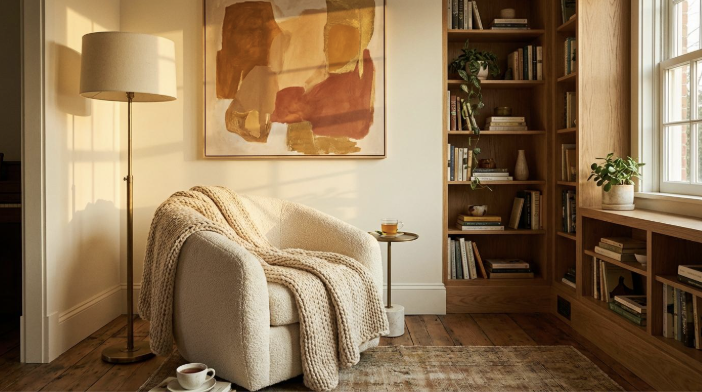
A living room reading corner featuring one large oversized framed artwork above a reading chair
Most reading nook guides spend all their energy on what happens at chair level — seating, lamps, side tables. But the wall behind and beside you is prime real estate for making the space feel complete, and it is consistently the most overlooked element.
A bare wall makes even the most perfect chair setup feel unfinished. It’s the visual equivalent of a beautiful frame with nothing in it. The right artwork transforms a corner from “a place I sit” into “my reading nook” — it signals intention, adds personality, and gives the eye something meaningful to rest on when you look up from the page.
Size is where most people go wrong. The instinct is to choose a modest print — something tasteful, not too bold. But interior designers recommend that artwork span roughly 60 to 75% of the available wall space above furniture, and in a living room reading corner, that usually means going larger than feels comfortable at first. A single large statement piece creates far more visual cohesion than several small prints scattered around the same wall. It anchors the corner, draws the eye, and defines the space as deliberately designed rather than casually assembled.
For a living room reading corner, one oversized statement piece does more design work than a whole gallery wall of small frames. If you want to see what that looks like in practice, browsing collections of extra large framed wall art for living room spaces is a genuinely useful exercise — the scale alone changes how the entire corner reads, and what felt like a lot suddenly makes complete sense in context.
When it comes to subject matter, choose art that speaks to your reading life. Literary landscapes, abstract pieces in warm earthy tones, a nature scene that evokes a beloved setting from a favorite novel. Avoid anything too busy or visually loud — the art should create calm, not compete with your ability to focus. Zillow’s 2026 trends data notes that artisan craftsmanship and vintage accents in home decor are both surging (up 21% and 17% respectively in listings) — and original or artist-made wall art fits both categories perfectly.
On building a personal art collection: it doesn’t have to happen in a single shopping trip. Starting with one meaningful statement piece — something you genuinely love — is the right approach. Get the scale right first, live with it, and let the rest of the space grow around it.
A quick hanging note: center the piece at eye level, which interior designers put at roughly 57 inches from the floor to the center of the artwork. If it’s going above your reading chair, leave 6 to 8 inches of breathing room between the top of the chair and the bottom of the frame.
The Finishing Touches: Plants, Scent, and Personal Details
A reading nook earns its coziness in the details. A small plant nearby — a pothos, a peace lily, a trailing fern — adds a living, breathing quality to the space that photographs and prints simply cannot replicate. Plants also genuinely improve air quality, which makes the case for them purely practical as well as aesthetic.
Scent is underrated as a reading nook tool. A candle or a diffuser with a consistent signature scent — something you use only in this space — trains your nervous system to associate that smell with the act of settling in to read. It’s a form of environmental cueing, and it works. Within a few weeks, lighting the candle will be enough to shift your brain into reading mode before you’ve even opened a page.
For the final layer of personality: a few meaningful objects that have stories attached to them. A postcard from a city you’ve visited, a small piece of pottery from a local market, an object that makes you smile when you see it. Before committing to any purchases, it can help to do what interior designers call cohesive interior design planning — laying out your pieces together before they go on shelves or walls, so you can see how the colors and textures interact.
And finally: keep screens out of the nook. Leave your phone face down on the side table. The whole point of the space is a refuge from the pull of the feed, the notification, the next thing. Your reading nook should be the one place in your home where the only thing competing for your attention is the next chapter.
Your Nook, Your Rules
A reading nook isn’t a luxury reserved for people with spare rooms and generous square footage. It is, at its core, a decision — a deliberate choice to carve out a corner of your home that belongs to your reading life, and to treat that life as something worth designing around.
The framework is simple: a chair that holds you for hours, light that doesn’t strain your eyes, shelves within reach, walls that mean something, and a few personal details that make the space feel like no one else’s. You don’t have to do it all at once. Start with the chair. Add the light. Let the rest come.
Then pour the tea, find your page, and don’t come up for air until you’re ready.