

496-lb Biggest Book in the World Made by 1,000 Kids
Over 1,000 student authors collaborated to publish "I Am Texas," a colossal 496-pound volume that officially broke the Guinness World Record for the biggest book in the world in the published category. This monumental achievement proves that young writers can accomplish impossible feats when given the right platform.
The kids involved in this massive project embraced the creative writing process early and secured a world record before even finishing high school. Right now in 2026, this giant literary achievement still inspires classrooms across the entire nation.
Why a local literacy organization launched this campaign
Planners designed this massive initiative to make historical research exciting by letting kids participate in breaking a global record. Reading history from a dry textbook rarely captures the imagination of an elementary school student.
The campaign asked kids from third through twelfth grade to explore their local heritage and write original pieces about their home state. The task was basically asking these kids to write my personal statement for me about Texas, themselves, and their families. This creative prompt generated a massive wave of highly emotional and well-researched submissions.
The participating students submitted work across multiple creative formats:
Fictional short stories
Historical essays
Pencil illustrations
Rhyming poetry
Inspiring kids beyond standard classroom testing
Offering a tangible, record-setting incentive proved that students will voluntarily revise their writing without complaint. Standardized testing often drains the joy out of creative writing for young learners.
When children feel like they are only writing to pass a state exam, their natural creativity shuts down. Offering a world record completely flipped that boring educational script.
Teachers reported that their classrooms were buzzing with energy during the drafting phases.
How young learners became published record holders
Students from diverse backgrounds submitted their original stories through a free, open portal managed by museum staff. The barrier to entry was kept intentionally low to encourage participation from underfunded public school districts.
A team of professional authors blindly reviewed the entries without knowing the age or background of the creator. This blind judging process ensured that only the most compelling stories made it into the final layout.
Celebrity author support and mentorship
Bestselling author Brad Meltzer championed the literacy initiative by writing the official foreword for the massive edition. Having a famous writer validate their hard work gave these young participants a massive confidence boost.
Meltzer frequently uses his platform to highlight everyday heroes, making him a great ambassador for this student-led mission. His involvement also helped attract national media attention to the children's achievements.
News cameras flocked to the unveiling ceremony to watch the massive cover open for the very first time.
The exact dimensions of the record-breaking Texas project
The completed book stands exactly 7 feet 2 inches tall and spans over 11 feet wide when laid completely open. When people ask about the largest book in the world created by young students, they are often amazed by these physical height and width measurements.
Exhibiting a text of this magnitude safely requires custom, heavy-duty display furniture. The physical footprint spans roughly 79 square feet when opened, completely dwarfing conventional reading materials.
Furthermore, because the team aimed for an official certification in the published category, this massive footprint could not just be a static art piece. They had to meet strict structural criteria dictating exactly how the book was built:
The final product must feature a registered ISBN for standard commercial ordering.
Its structural binding has to function exactly like a traditional consumer hardback.
Readers must be able to turn the pages consecutively without damaging the spine.
Physical specifications of the Texas publication compared to standard novels
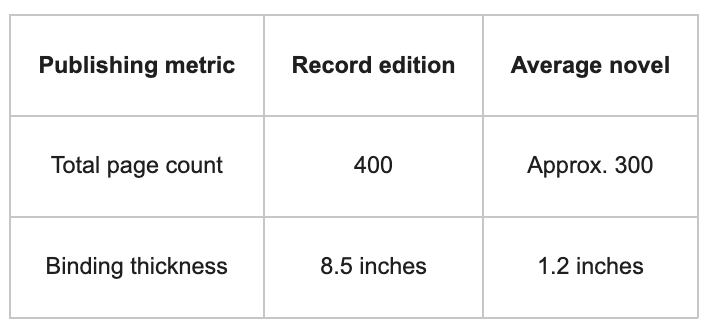
Source note: Compiled publisher manufacturing dimensions.
How organizers physically constructed the massive pages
Printing a document this large required specialized UV printers typically used for large-format commercial graphics. Standard printing presses simply cannot handle materials wider than a few feet.
Constructing the biggest book in the world required exact precision from dozens of manufacturing experts. The production team used high-quality, large-format paper instead of vinyl to maintain an authentic literary feel.
Transforming these massive printed sheets into a functional book posed an incredible engineering challenge. Instead of relying on heavy metal bolts or steel brackets, workers physically constructed the giant text using traditional, upscaled methods:
Hand-stitching heavy paper sections together with thick thread
Applying industrial adhesives using large commercial paint rollers
Custom-building oversized wooden tools to fold the sheets accurately
Overcoming the traditional publishing limits
Sourcing standard bookboard wide enough for an eleven-foot cover spread was the single hardest materials challenge. Traditional suppliers simply do not manufacture hardback cover supplies at that massive scale.
The production team had to creatively fuse materials together to create a seamless, rigid exterior. Once the giant cover was assembled, the team had to ensure the interior matched that high quality. Every single letter printed inside had to be perfectly crisp and legible from several feet away.
The role of independent binderies in record-breaking feats
Creating a massive published volume required relying on local Houston artisans who possessed specialized restoration skills. Mass-production facilities are entirely reliant on automated machines that cannot process seven-foot pages.
These specialized bookmakers adapted their entire workspace to accommodate the massive project. Standard bone folders used in normal bookbinding were practically useless against the massive surface area.
Testing the physical limits of traditional glue
Bookbinding adhesive performs unpredictably when spread over giant surface areas, requiring precise humidity control during the curing process. The artisans had to experiment with different drying times to ensure the spine would remain flexible.
If the adhesive dried too brittle, the entire back of the book would shatter the first time it was opened. By carefully managing the room temperature, the bindery ensured the adhesives cured perfectly.
Their meticulous attention to detail allowed a massive art project to function exactly like a regular library book.
The realistic logistics of moving a massive publication
Transporting this heavy volume requires a custom padded wooden crate and heavy-duty furniture dollies.
While a 496-pound object seems intimidating, it does not threaten standard venue floor weight capacities. This worlds biggest book can travel securely on transport carts designed to pass easily through commercial double doors, meaning venues merely need a clear loading dock path to receive it.
Once the text is safely stationed for display, the focus shifts to standard museum handling protocols. Turning the pages does not demand extreme acrobatics; it simply requires two docents to lift the corners of the heavy paper simultaneously to prevent creasing the artwork.
Expanding the educational impact beyond the world record
Organizers printed thousands of standard-sized replica copies to raise funds for free writing workshops in low-income schools. The world record was never just a vanity project; it served as a highly practical fundraising tool.
Selling the standard editions generated critical revenue that directly benefits struggling classrooms. The educational foundation continues to use those specific funds to provide resources to students across the region.
They bring professional illustrators and authors directly into underfunded classrooms. This ensures that the magic of the project continues to impact new generations right here in 2026.
Taking the literary giant on tour
The massive artifact toured prominent cultural landmarks so young visitors could view their published work in person. Seeing a picture of a giant book on a smartphone does not convey the true magic of its scale.
Standing next to a novel that is taller than a professional basketball player leaves a lasting impression on young minds.
These public viewing events turned ordinary student writers into local celebrities. Entire families traveled long distances just to find their child's text printed on the massive pages.
General preservation strategies for oversized paper artifacts
Protecting an oversized volume requires flat storage options, steady climate controls, and non-UV lighting to prevent rapid paper degradation. Museums across the globe follow universal archival guidelines to protect any fragile paper artifacts from environmental damage.
Archivists must maintain a consistent environment to keep the heavy paper sheets from curling or absorbing ambient moisture. If the air becomes too dry, the glue along the hand-stitched spine can weaken over time.
Exhibiting these large works also requires resting the spine at a slight incline rather than standing it completely upright. This subtle angle relieves pressure on the bottom page edges.
Universal environmental preservation standards
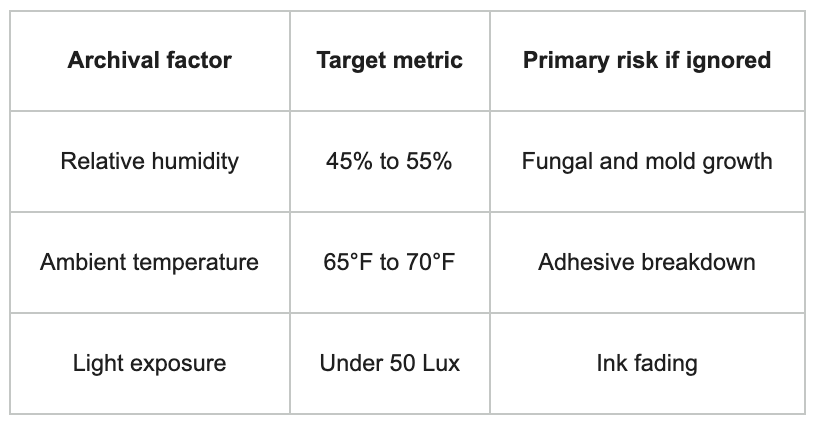
Source note: Standard archival preservation guidelines for historical paper artifacts.
Similar massive student projects: The Pages for Peace initiative
Long before the Texas project, a group of fifth-grade students in Massachusetts began constructing their own massive literary monument to promote global unity. Known as the Pages for Peace project, this massive undertaking took over twelve years to complete. The initiative collected letters and drawings dedicated to peaceful resolutions.
The project attracted written submissions from an incredible variety of international figures:
Former United States presidents
Global spiritual leaders
Dedicated peace activists
Ordinary school children
Renowned scientists
How a middle school club built a one-ton monument
The finished peace book stands 10 feet tall and 12 feet wide when fully open. This makes it an incredible contender for the biggest book ever created entirely by a school club.
While it was not commercially published like the Texas project, it still serves as a massive testament to student dedication. It currently resides in special museum exhibits where visitors can read the international messages.
College-level projects: MIT’s Himalayan Odyssey
Universities also experiment with record-setting publishing to raise funds and awareness for global initiatives. In 2003, researchers at the Massachusetts Institute of Technology produced a stunning visual book about Bhutan. This project held the official global record for several years.
When exploring the history of giant books, this specific volume stands out as a pioneer of modern large-format printing. The worlds largest book at that time measured five by seven feet when fully opened.
Historical timeline of massive global texts discussed in this article
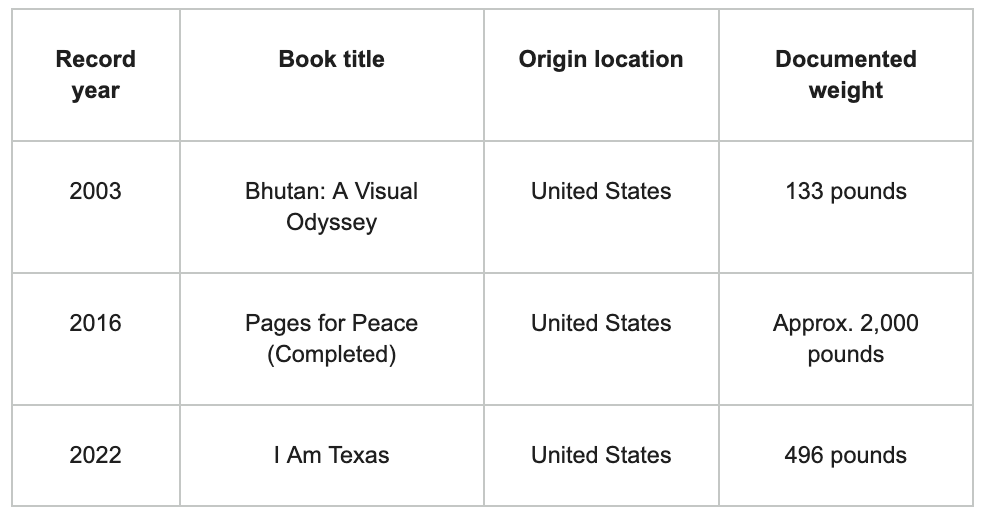
Source note: Documented measurements comparing the specific giant texts mentioned in the article.
Raising funds through monumental photography
MIT students and faculty used the profits from selling scaled-down versions to build new schools across the Himalayas. When asking what is the biggest book in the world, historians often point to this specific volume as the spark for modern giant printing.
It successfully proved that massive novelty items could generate real-world philanthropic funding.
Frequently asked questions about giant books
Here are answers to the most frequent questions regarding massive books.
What is the biggest book in the world?
The answer depends entirely on whether you measure by overall weight or commercial availability. While ancient stone pillars hold historical claims, any world biggest book printed on paper relies on modern binderies.
In 2012, a colossal text in the United Arab Emirates titled This the Prophet Muhammad claimed the title for the heaviest book overall, weighing over 3,300 pounds. However, the Texas student project holds the title specifically for the largest published book available for public purchase.
How do you measure the largest book in the world?
To accurately determine what's the biggest book in the world, Guinness World Records measures the total square footage of the open pages alongside the overall physical weight. However, measuring the largest book in the world in the published category also requires evaluating strict functional criteria.
Judges evaluate these publishing projects based on structural integrity, page turnability, and public purchasing options. The document must feature a functional hardback spine, proper page sequencing, and an ISBN to qualify as a real publication rather than just a massive art piece.
Where can you see world record books today?
To see the largest book in the world from any given era, you must usually visit specialized museum exhibits or university library archives. Most record-holding texts reside in climate-controlled environments equipped with reinforced display tables.
The Texas volume makes scheduled appearances at cultural institutions to promote student literacy across the country.