
Creating a Reading Schedule: A Practical Guide

Most people say they want to read more.
Then life happens.
Work drags on longer than expected. Phones steal twenty minutes here and there. You sit down with a book, read three pages, and suddenly realise you absorbed absolutely nothing because your brain was still replaying a conversation from earlier.
That is why reading schedules matter.
Not because reading should feel rigid or academic. Quite the opposite. A proper reading routine removes the friction that stops people from reading consistently in the first place.
And honestly, consistency matters far more than speed.
Reading ten pages every day beats reading fifty pages once every three weeks and forgetting half of it afterward.
Why Most Reading Goals Collapse After a Week
People usually start too aggressively.
They buy five books. Promise themselves they will read every night for two hours. Download productivity apps. Create colour-coded trackers.
Then by Thursday they are exhausted and avoiding the whole thing.
A reading schedule should fit your actual life, not the imaginary organised version of yourself that appears briefly every January.
That part matters.
The best reading habit is the one you can repeat without forcing it.
Start Smaller Than You Think You Need To
This feels counterproductive at first.
But smaller reading targets build momentum faster.
Instead of saying:
“I will read for an hour every night.”
Try:
“I will read for fifteen minutes before bed.”
That sounds almost too easy. Good. Easy routines survive busy weeks.
Once reading becomes automatic, increasing the time feels natural instead of exhausting.
A lot of schools now encourage structured reading habits early because regular exposure builds comprehension, vocabulary, and concentration gradually over time. Educational environments like Blue Coat School in Edgbaston often emphasise consistent independent reading because long-term literacy grows through repetition, not cramming.
Figure Out When Your Brain Actually Works
This part gets ignored constantly.
Some people read best early in the morning when everything feels quiet and clear. Others absorb information properly only at night once the noise of the day disappears.
There is no universally perfect reading time.
The trick is noticing when your concentration naturally lasts longer.
For example:
Morning readers often prefer nonfiction or study-heavy books
Evening readers usually lean toward fiction or slower reading
Commute readers benefit from audiobooks or shorter chapters
Weekend readers sometimes prefer longer uninterrupted sessions
Trying to force reading into the wrong part of your day usually fails fast.
Build Your Schedule Around Realistic Reading Blocks
People imagine reading requires huge uninterrupted stretches of time.
It does not.
Even twenty focused minutes counts.
Actually, shorter sessions are often more effective because concentration stays sharper.
A simple weekly structure might look like this:
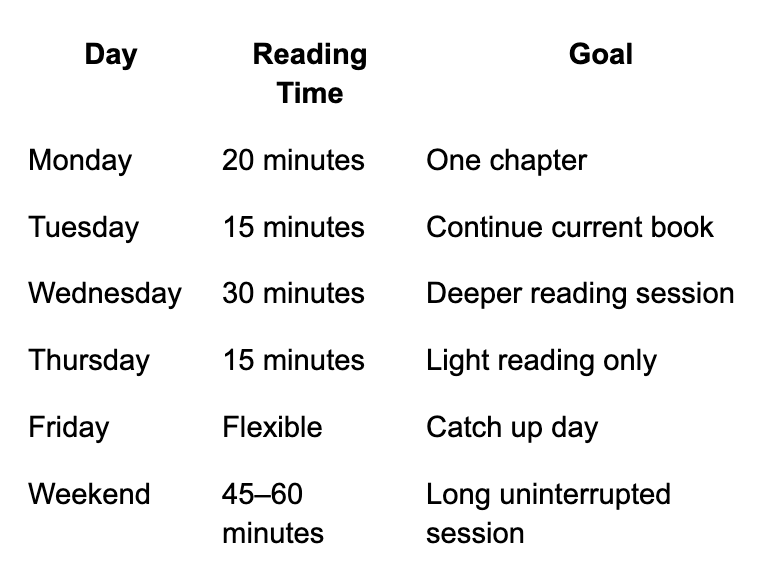
Nothing extreme. That is the point.
Stop Treating Every Book Like Homework
This changes everything for a lot of people.
You do not need to finish every book you start.
Really.
Some books are badly written. Some are boring. Others simply arrive at the wrong time in your life.
Forcing yourself through books you dislike turns reading into obligation instead of enjoyment.
A better reading schedule includes variety.
Maybe:
Fiction before bed
Nonfiction in the morning
Audiobooks during travel
Essays or articles during short breaks
Different formats prevent burnout surprisingly well.
Physical Books Versus Digital Reading
People argue about this endlessly.
Truthfully, both work.
Physical books reduce distractions because notifications are not flashing every few minutes. Digital reading, though, makes consistency easier because your book travels everywhere with you.
The better option is whichever one you will actually use consistently.
That is it.
Some readers even mix formats depending on mood or location.
And audiobooks absolutely count as reading, despite what certain internet debates insist.
Tracking Progress Without Becoming Obsessed
Tracking helps. Overtracking becomes exhausting.
A simple checklist or notebook is usually enough.
Write down:
What you read
How long you read
One thought about it
That final part matters most because reflection improves retention.
You do not need complicated productivity systems unless you genuinely enjoy them.
Otherwise the tracking becomes bigger than the reading itself.
What To Do When You Fall Behind
You will.
Everybody does.
Vacations happen. Stressful weeks happen. Sometimes your brain simply refuses to focus.
The mistake is treating missed days like failure.
Reading schedules should bend slightly without breaking completely.
Missing three days does not erase months of progress.
Just restart.
Quietly.
Without guilt turning a tiny interruption into a permanent stop.
Reading More Does Not Mean Reading Faster
There is strange pressure online to consume books competitively.
Fifty books a year. One hundred books a year. Speed-reading challenges everywhere.
But racing through books often weakens comprehension.
A slower reader who genuinely reflects on ideas usually gains more than somebody skimming pages just to hit a number.
Reading is not really about finishing.
It is about absorbing.
Final Thoughts
A good reading schedule should feel supportive, not restrictive.
The goal is not perfection. It is rhythm.
Small reading sessions repeated consistently almost always outperform ambitious routines that collapse after a week or two.
Start smaller than feels necessary. Read at the times your focus naturally works best. Mix formats if needed. Stop forcing books you hate.
And most importantly, make reading part of your life instead of another task sitting heavily on top of it.
Because once reading becomes habitual, something strange happens.
You stop trying to “find time” for books.
You just naturally reach for one.