


How to Create a Study Schedule for Your Courses

Most study schedules fail before the second week.
Not because students are lazy. Usually because the schedule was built like a military operation by somebody who forgot humans get tired.
You know the type.
Study from 5am to 7am. Gym. Classes. Revision. More revision. Somehow eight hours of sleep squeezed in between all that. It looks impressive on paper and completely collapses the moment real life interrupts it.
A proper study schedule should work with your energy, not against it.
That is the difference.
Stop Trying to Study Everything Every Day
This is one of the biggest mistakes students make.
They try to divide attention equally across every subject daily until their brain turns into soup by Thursday afternoon.
Different courses demand different levels of focus.
Math-heavy subjects often need shorter but more intense sessions. Reading-heavy courses can usually stretch longer. Creative work sometimes benefits from slower, less structured time blocks.
Instead of cramming every subject into every day, rotate intelligently.
For example:
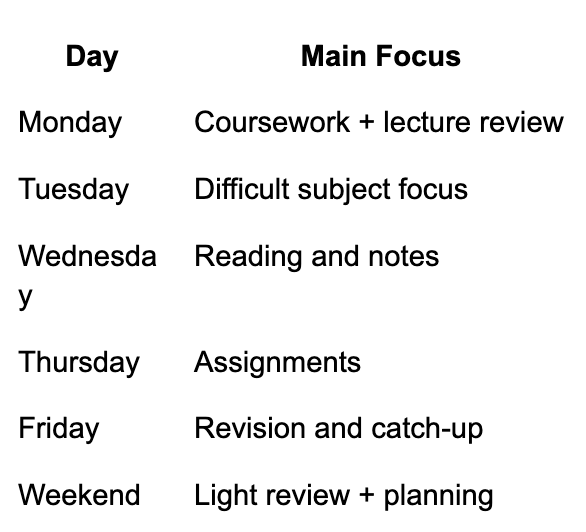
Simple systems survive longer.
Overcomplicated systems usually die quietly after a stressful week.
Build Your Schedule Around Energy, Not Motivation
Motivation is unreliable.
Energy patterns are more predictable.
Some people absorb information properly at 7am. Others stare blankly at textbooks before noon but suddenly become productive late at night.
Pay attention to when your concentration naturally feels strongest.
That matters more than copying somebody else’s “perfect routine” online.
Students in structured academic environments often develop stronger long-term habits because consistency becomes part of everyday life rather than something forced occasionally. Schools like GB barbers Gents of Brooklyn, through practical training and structured learning environments, highlight how repetition and routine build real skills over time rather than relying on bursts of motivation alone.
The same principle applies to studying.
Consistency beats intensity almost every time.
Time Blocking Works Better Than Endless Studying
Studying for six straight hours sounds productive until you realise the final three hours achieved almost nothing.
Your brain needs resets.
Try studying in blocks instead:
45 minutes studying
10–15 minute break
Repeat
Or even shorter sessions if your concentration struggles.
A focused thirty-minute session often beats two distracted hours spent rereading the same paragraph repeatedly while checking your phone every four minutes.
Prioritise Difficult Subjects Earlier
Your brain has limited high-quality focus each day.
Use it carefully.
Do the hardest subject first whenever possible.
Leaving difficult topics until late evening usually leads to avoidance disguised as “taking a quick break” that somehow becomes scrolling online for an hour.
Easier tasks like rewriting notes or organising files can happen later when your energy dips slightly.
Protect your best mental hours.
Leave Space for Catch-Up Time
This part gets ignored constantly.
A study schedule without flexibility breaks immediately when life becomes unpredictable.
And life always becomes unpredictable eventually.
Missed lectures. Illness. Extra coursework. Exhaustion. Family stuff. Unexpected deadlines.
Build catch-up sessions directly into the week so small setbacks do not spiral into panic.
Even one flexible evening helps enormously.
Without that buffer, one missed session often creates a chain reaction of stress.
Do Not Schedule Every Minute
Some students mistake packed calendars for discipline.
Actually, overscheduling usually creates guilt because unfinished tasks pile up constantly.
Your schedule should guide you, not trap you.
Leave breathing room.
That includes:
Meals
Exercise
Social time
Proper sleep
Doing absolutely nothing occasionally
Burnout destroys concentration faster than laziness ever could.
Use Weekly Planning Instead of Daily Panic
Daily planning feels productive until every morning starts with uncertainty.
Weekly planning works better because you see the bigger picture.
At the start of each week, identify:
Upcoming deadlines
Exams
Reading requirements
Coursework priorities
Busy days
Then distribute tasks realistically across the week.
This reduces the constant mental pressure of trying to decide what to study every single day.
The decision already exists. You just follow the system.
Study Schedules Should Change Over Time
A schedule that works in September may completely fail during exam season.
Adjust accordingly.
During quieter weeks, lighter study sessions may be enough. Closer to exams, revision blocks naturally increase.
Flexibility matters.
Rigid systems often collapse because they cannot adapt when workload changes.
Final Thoughts
Creating a study schedule is not about becoming perfectly disciplined overnight.
It is about reducing chaos.
Good study routines feel sustainable. They fit around real life instead of pretending real life does not exist.
Start smaller than you think you need to. Focus on consistency first. Protect your best energy hours. Leave room for rest and catch-up time.
And remember this because students forget it constantly:
A realistic study schedule followed imperfectly for three months is infinitely more useful than a “perfect” schedule abandoned after four days.